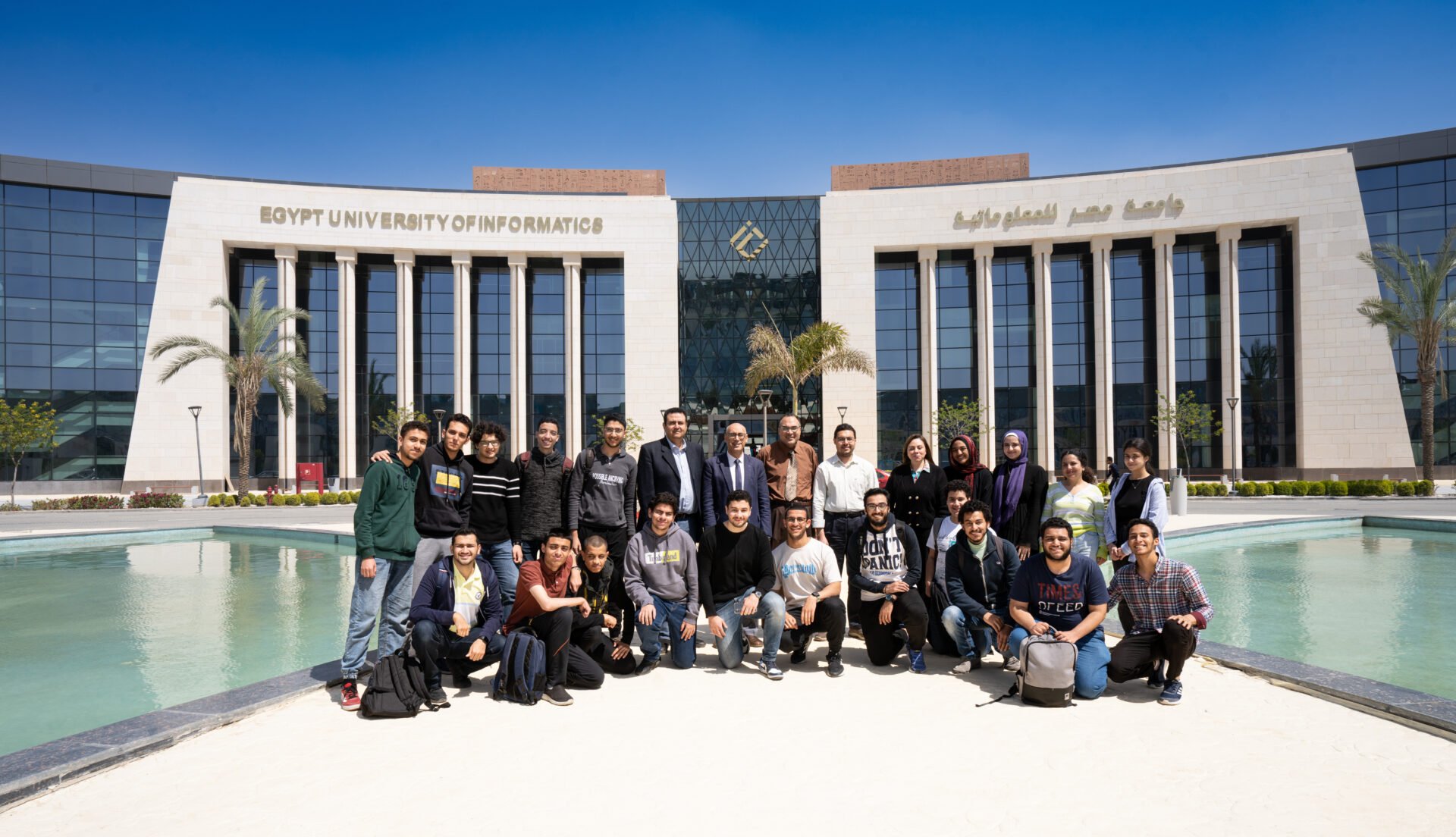


EUI Hosts Ugandan Delegation for AI and Digital Transformation Visit

Egypt University for Informatics (EUI), located in the Knowledge City in the New Administrative Capital, welcomed Her Excellency, Ms. Joyce Nabbosa Ssebugwawo, Uganda's Minister of State for Information, Communications and Technology, who is currently visiting Egypt at the head of a Ugandan delegation. The visit aimed to explore ways to strengthen joint cooperation in priority technology sectors, led by artificial intelligence, digital transformation, data centers, and telecommunications infrastructure, including fiber-optic networks, as well as opportunities to exchange expertise and learn from successful experiences in these fields.
Prof. Ahmed Hamad, Acting President of EUI, said the Ugandan minister and the accompanying delegation held an extensive meeting with the university's leadership, during which the university affirmed its readiness to cooperate with the Ugandan side across five areas:
Digital capacity building: The university can design and deliver a training program for Ugandan professionals in artificial intelligence, cybersecurity, and data analysis.
University and postgraduate education: This includes scholarships for Ugandan students, exchange of faculty members and students, and joint research supervision in cooperation with Ugandan universities.
Applied scientific research: Joint projects in artificial intelligence, smart communications, cybersecurity, and digital applications.
Entrepreneurship and innovation: Incubating joint Egyptian-Ugandan student projects and developing technology applications that serve African communities, in cooperation with Ugandan innovation institutions.
Digital media and government communication: Specialized training in digital media, interactive design, and countering misinformation, in cooperation with the relevant Ugandan entities.
Prof. Hamad added that this cooperation will benefit from the network of international relationships and agreements EUI has built over the past five years with universities, research centers, and industrial companies. These include dual-degree agreements with leading universities in the United States, Canada, France, the United Kingdom, Japan, and other countries, covering artificial intelligence, gaming, and advanced engineering. These partnerships have given graduates and faculty members distinguished experience and capabilities, reflected in the university's success in winning a research project funded by the European Union's Horizon Europe program (GAINAfrica), in its first participation as a funded beneficiary in European research and innovation projects.
The project focuses on developing education, healthcare, agriculture, urban planning, and infrastructure systems across Africa by creating comprehensive AI solutions that take local contexts into account and address the continent's pressing societal needs. Entities from Uganda take part in the project alongside partners from Egypt, Italy, France, Tunisia, Morocco, and Benin.
He stressed that EUI is ready to cooperate with Ugandan universities in scientific research and innovation on any projects of interest to the Ugandan side, offering all the capabilities of the university, its four faculties, and its research centers to make this cooperation succeed. This supports efforts to strengthen relations between Egypt and Uganda and the aspirations of the two friendly peoples for prosperity and well-being.
Regarding the Ugandan delegation's discussions during the meeting, Prof. Hamad said they focused on benefiting from EUI's experience and capabilities in building digital capacity, developing the industry sector, applied research, and innovation. He noted that the university adopts an educational model combining specialized education, hands-on projects, applied research, entrepreneurship, and openness to industry. Its link with the Ministry of Communications and Information Technology also places it within a broader national system that supports digital transformation. This experience can help guide Uganda in developing capacity-building programs tailored to its own priorities and institutional needs.
Responding to the Ugandan side's question on aligning education with industry requirements, Dr. Amany Essa, Director of the Entrepreneurship and Innovation Center, explained that cooperation includes advice on curricula, practical training, mentoring, and joint supervision of graduation projects, which are designed to address real challenges faced by companies. The university's four faculties also enable multidisciplinary collaboration, helping students combine technical, business, and design skills to develop practical solutions for various industries.
She added that EUI regularly reviews and updates its curricula based on feedback from industry advisory councils, international academic partnerships, and participation in research projects. These links help identify newly required skills and professions and bring relevant technologies into the educational process. Building strong foundations in computer science, engineering, and problem-solving also prepares students to adapt to rapidly evolving technologies, especially artificial intelligence.
On business process outsourcing, she affirmed that it is an important area for developing ICT-based economic opportunities. The Ugandan side can benefit from the university's expertise in preparing the workforce needed for ICT-enabled services, such as computing, big data analytics, business information systems, and professional skills development.
On how to turn research results into applications with economic value, Dr. Amal El-Gamal, Head of International Relations, said the university encourages projects inspired by smart technologies, such as NARRATE, which addresses challenges related to manufacturing and supply chains, alongside efforts to develop applications serving agriculture, education, and public services in cooperation with specialized partners.
On advanced manufacturing, she said it requires integrated expertise in engineering, computing, business, and design, and a multidisciplinary approach to industrial challenges. Applied projects can link artificial intelligence, digital twins, and data integration with production efficiency, flexibility, and sustainability. She noted that Industry 5.0 continues to emphasize the importance of human participation, with technology supporting people in understanding alternatives and making informed decisions based on multiple factors.
She added that protecting intellectual property and registering patents for research and innovation results is an important issue. Ownership boundaries, contributors' rights, and partners' responsibilities should be clarified early in collaborative projects. She noted that the university's Entrepreneurship and Innovation Support Center can assist the Ugandan side in this area and show them how to determine the appropriate form of protection depending on the nature of the research results, whether an invention, software, a creative work, or confidential know-how.
Attendees from the Ugandan side: Sylvia Kizito Birahawa, Assistant Commissioner for Information and Publishing; Irene Karungi Sekitoleko, Principal Officer for Information Infrastructure and Secretariat of the National AI Task Force; Monica Aluero, Senior Information Technology Officer; Gorret Nabyonga, Personal Assistant to the Minister; Brandy Aziroweh, Communications Officer; Winnie Nankanja, National Guidance Officer; Dr. Teddy Nalubega, Head of the AI Department and the National AI Task Force at Knowledge Consulting Limited; Julian Rwijo, Director of E-Government Services at the National Information Technology Authority; Vincent Lwajola Mangeni, Director of ICT Systems at the National Planning Authority; and Zeina Nanyi, Economist at the Ministry of Finance, Planning and Economic Development.
Attendees from the Egyptian side: Samah Aziz, Head of the Central Administration for International Relations at the Ministry of Communications and Information Technology. From EUI: Prof. Ashraf Mehran, Dean of the Faculty of Engineering; Prof. Hoda Mokhtar, Dean of the Faculty of Computing and Information Sciences; Prof. Mohamed Saleh, Dean of the Faculty of Business Informatics; and Prof. Ashraf Zaki, Dean of the Faculty of Digital Arts and Design.


